Foundation models for time series forecasting and policy evaluation in infectious disease epidemics
Abstract
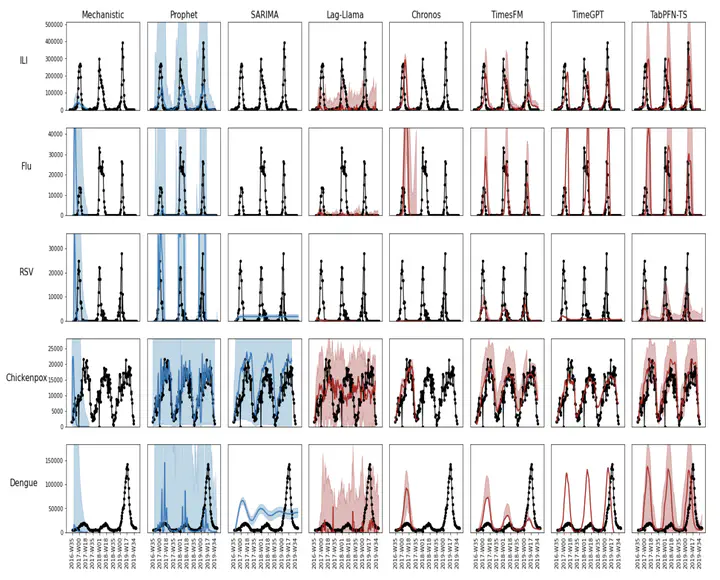
Epidemic forecasting and public health policy evaluation rely on mathematical models, but traditional approaches struggle in data-limited settings. We evaluated whether transformer-based, foundation Artificial Intelligence models can serve as a new epidemic modeling framework. We tested five models across pathogens and locations, including influenza, respiratory syncytial virus (RSV), chickenpox, dengue. Foundation models demonstrated strong accuracy in short-term forecasts and predicted multiple epidemic waves. They outperformed standard implementations of established models on limited and irregular data. We showed foundation models can generate scenarios for policy evaluation, estimating the effect of tighter restrictions on COVID-19 cases during the Alpha variant surge in Italy in 2021. We also used them to estimate the effectiveness of the 2023 RSV immunization campaign in Paris, France. Our findings suggest foundation models can complement existing modeling approaches. Their ability to generate forecasts and counterfactual analyses with minimal data highlights their potential for public health, particularly in emergent and resource-constrained settings.

Suprabhath Kalahasti
PhD student

Benjamin Faucher
Postdoctoral researcher

Boxuan Wang (王博玄)
PhD student

Claudio Ascione
PhD student

Federico Baldo
visiting PhD student