Redefining and estimating the early-phase reproduction ratio for epidemic outbreaks in spatially structured populations
Abstract
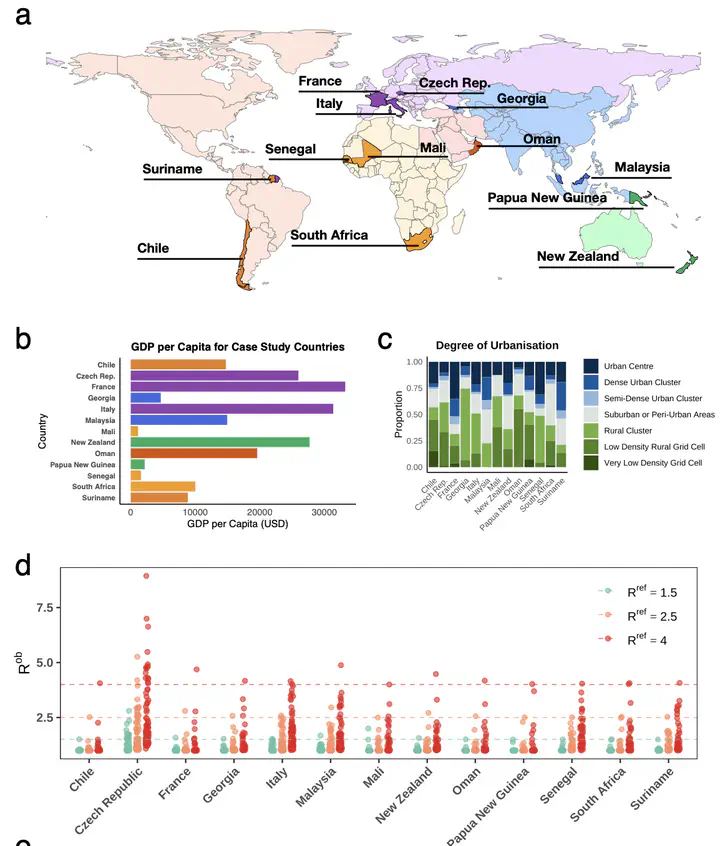
Assessing epidemic risk following pathogen introduction is crucial in infectious disease epidemiology. Risk is commonly encoded through reproduction ratios, which underpin operational decision-making. In spatially structured populations, both local and cross-community transmission shape epidemic trends, a feature that standard reproduction ratios fail to capture simultaneously. Here, we use multitype branching processes to define the outbreak reproduction ratio $R^{ob}$, a reformulation applicable across pathogens, epidemics and transmission routes, enabling community-specific, but system-aware, risk assessment. We test $R^{ob}$ on respiratory pathogens and estimate it prior to emergence using aggregated contact matrices, enabling spatially resolved risk assessment even with limited data and computational resources. Estimates across countries reveal heterogeneous spatial risk, not captured by standard metrics. $R^{ob}$ can also be estimated from early-phase surveillance data, as we show using SARS-CoV-2 in Canada, where it correctly identifies community risk. $R^{ob}$ represents a concise and practicable framework for interpreting epidemic risk in spatially structured populations.

Boxuan Wang (王博玄)
PhD student