Global dynamics of antibiotic resistance: a modeling study of the spread of endemic and emerging resistance in E. coli
Abstract
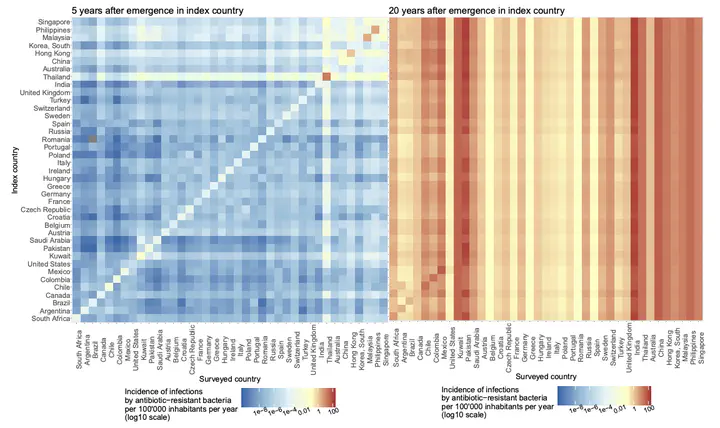
Background Antibiotic resistance (ABR) poses a growing threat at the global level. Emergence and worldwide dissemination of multi-resistant clones are frequently reported. However, associated drivers are still largely unknown and are a crucial knowledge to mitigate ABR risk in humans. Methods We used mechanistic modeling to analyze annual trends of extended-spectrum β-lactamase-producing Escherichia coli (ESBL-EC) in 39 countries over 2006-2019. The model formalizes ESBL-EC transmission, colonization and infection at the country and global levels, accounting for heterogeneous antibiotic prescriptions and human mobility. The fitted model is used to explore hypothetical scenarios of emerging antibiotic-resistant clones like carbapenem-resistant E. coli (CR-EC) and evaluate their global dissemination risk. Findings International travels alone do not explain heterogeneous ESBL-EC dynamics. Reproducing observed trends requires accounting for antibiotics impact on ESBL-EC acquisition and heterogeneous within-country transmission rates. Strong differences in transmission rates are inferred between Europe and South-East Asia, ranging on average from 7.05×10⁻³ day-1 in Spain to 16.21×10⁻³ day-1 in Thailand. For CR-EC, spatiotemporal dynamics depends on the explored emergence scenario. We show that mobility patterns drive 5-years resistance dynamics, while 20-years dynamics are mostly predicted by within-country transmission and antibiotic use. Interpretation This spatiotemporal analysis highlights the weight of international travel in the early global dissemination of antibiotic-resistant clones but suggests that reducing transmission and selection pressure is fundamental to avoid fixation. There is a need to strengthen surveillance and data collection of community colonization and infection to refine modeling and support decision and ABR control at the global scale.